
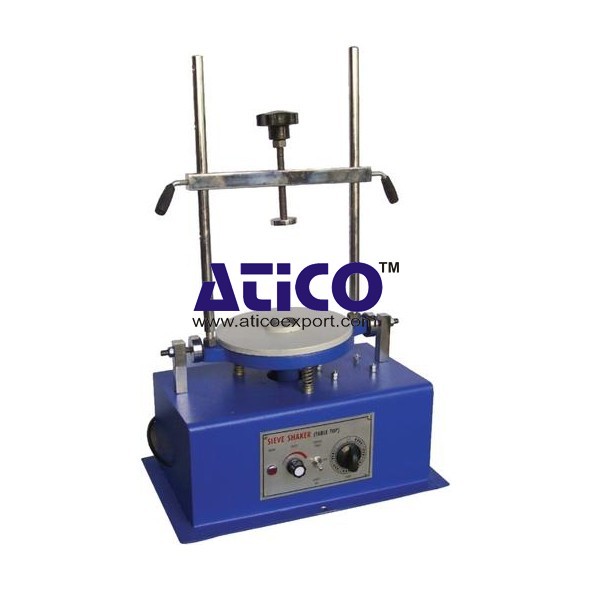
Table Top Sieve Shaker
Categories:Table Top Sieve Shaker Technical Specifications : Applications - separation, fractioning, particle size determination Feed material - Sands, crushed rock, clays, granite, feldspars, coal, soil, a wid...





Product
Description
Table Top Sieve Shaker Technical Specifications : Applications - separation, fractioning, particle size determination Feed material - Sands, crushed rock, clays, granite, feldspars, coal, soil, a wide range of manufactured powders, grain and seeds Measuring range - 37micron to 4mm Max. mass of sieve stack - 6 Test sieves of 200 mm Dia with Lid and pan. Set Timer - 0-60 minute timer ( Optional) Power Supply - 220/230 volts A.C Method The vertical throwing motion is overlaid with a slight circular motion which results in distribution of the sample amount over the whole sieving surface. The particles are accelerated in the vertical direction. In the air they carry out free rotations and interact with the openings in the mesh of the sieve when they fall back. If the particles are smaller than the openings, they pass through the sieve. If they are larger, they are thrown upwards again. The rotating motion while suspended increases the probability that the particles present a different orientation to the mesh when they fall back again and thus might eventually pass through the mesh. Standard Accessories: Two supporting SS rods, sieve retaining assembly and rubber pad. Optional Accessories: Test Sieves, Pan and cover, Calibration certificate for the sieves.
quick overview :
Table Top Sieve Shaker Technical Specifications : Applications - separation, fractioning, particle size determination Feed material - Sands, crushed rock, clays, granite, feldspars, coal, soil, a wide range of manufactured powders, grain and seeds Measuring range - 37micron to 4mm Max. mass of sieve stack - 6 Test sieves of 200 mm Dia with Lid and pan. Set Timer - 0-60 minute timer ( Optional) Power Supply - 220/230 volts A.C Method The vertical throwing motion is overlaid with a slight circular motion which results in distribution of the sample amount over the whole sieving surface. The particles are accelerated in the vertical direction. In the air they carry out free rotations and interact with the openings in the mesh of the sieve when they fall back. If the particles are smaller than the openings, they pass through the sieve. If they are larger, they are thrown upwards again. The rotating motion while suspended increases the probability that the particles present a different orientation to the mesh when they fall back again and thus might eventually pass through the mesh. Standard Accessories: Two supporting SS rods, sieve retaining assembly and rubber pad. Optional Accessories: Test Sieves, Pan and cover, Calibration certificate for the sieves.
Product
Reviews
add Review
reviews
No Review Yet.
Product
Reviews
add Review
reviews
No Review Yet.